

3D Printing
Rapid, Functional, Complex Geometries
Why Metal 3D Printing?

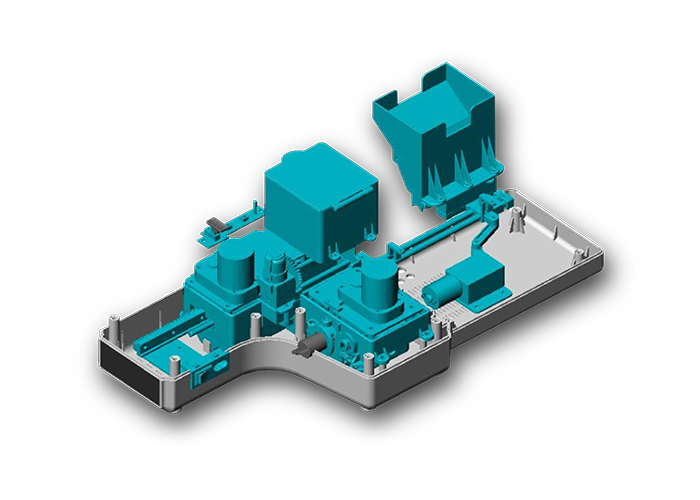
Complex Structure, No Assembling Needed
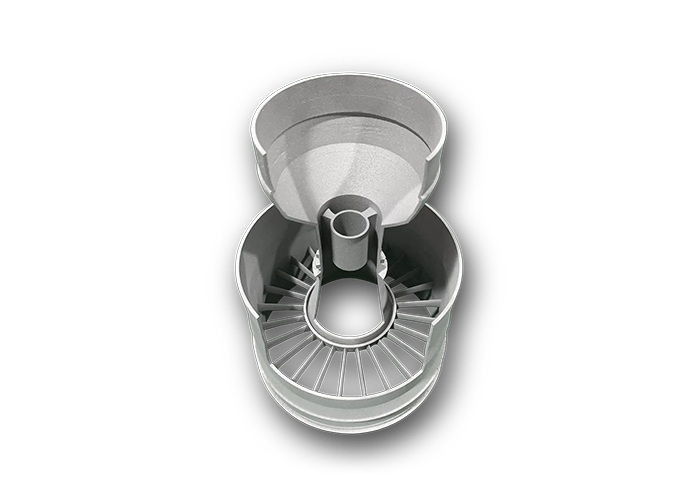
SLM metal 3D printing can effectively print intricate designs and challenging-to-machine items, including those with internal cavities, curves and tapered geometries, lengthy or partial thru-holes, conformal cooling channels, and metal mesh or lattice structures.
By combining several assembly into a single piece, the time and money spent cutting, welding, and assembling several components is saved.

Without Tooling
Ability to produce pieces without using tools. Custom tooling and fittings are necessary for many conventionally made products. Despite being essential to the production process, these parts take up manufacturing capacity without producing any money. Particularly for low volume manufacturing items, tooling expenses might make fabrication unaffordable.
Regardless of the items manufactured, a metal 3D printer does not require special tooling or fixturing configurations to operate. This decreases manufacturing overhead expenses and speeds up and lowers the cost of producing low-volume items.

Without Detailed Drawings or CAM
Drawings, CAM, or both are necessary for machined items, but not for 3D-printed metal parts.

Free Consultation & Instant Quote
Send us your CAD file or 2D draft, talk about your project with our experienced expert, and examine the manufacturability, choices of material, and processes.

Quick Production
With our connection to manufacturers in the neighboring regions, you can receive your parts in as less as 3 days.

Service with No Worries
We will keep reporting to you the production and shipping status once we get started.

Our Capabilities
Our 3D printing capabilities, which include the widest selection of technologies, materials, and finishing degrees available anywhere in the world, allow us to provide you with unbiased guidance on the best course of action for your project.
Simply upload your parts via our platform to get an instant quote.
Selective Laser Melting (SLM)
Selective laser melting (SLM), also referred to as direct metal laser melting (DMLM) or direct metal laser sintering (DMLS), is an Additive Manufacturing technique developed to melt and fuse metallic powders via a high power-density laser, through a computer-generated pattern to form the shape of 3D objects according to the CAD design.
A large variety of metal powders are available such as aluminum, titanium, copper, chromium, cobalt chromium, stainless steel, tool steel and superalloys.
| Requirement | Specification |
| Maximum build size* | 280 x 280 x 350 mm* |
| Standard lead time | 3-5 business days |
| Dimensional accuracy | ± 0.1% with a lower limit on ± 0.1 mm |
| Layer height | 0.035 mm |
*Our metal 3D printing service offers a larger build size capacity. Please get in touch with us if you need it.
 Current Projects
We cover a wide range of major metals for 3D printing with applications in multiple industries. This enables customers to achieve both unique prototypes and tailor-made end-use components.
Aluminium 3D Printing

metal 3d printing
complex features

metal 3d printing
industrial parts

metal 3d printing
complex shape

metal 3d printing
small parts

metal 3d printing
industrial parts

metal 3d printing
artistic curve

metal 3d printing
mass production
Stainless Steel 3D Printing

metal 3d printing
industrial parts

metal 3d printing
mirror finishing

sheet metal
mass production

metal 3d printing
abstract sculpture

metal 3d printing
mass production

metal 3d printing
industrial parts

metal 3d printing
industrial parts
Applications for Metal 3D Printing
This technology combines the design flexibility of 3D Printing with the mechanical properties of metal. From tooling inserts with cooling channels to lightweight structures for Automotives or Mechanical Components. Any application that involves complex metal parts potentially benefits from Metal 3D Printing. Below are some Industries we work with.
More Than Rapid
Prototyping is critical for product development, a real sample helps examine whether your design functions or not and where the flaws are. Without making a mold, a prototype comes to your hands in only a few days rather than a few months, which allows you to keep changing your mind and optimize your design.
Harder Housing
Nowadays, additive manufacturing is able to produce aerospace components and NASA rover’s parts which need metal with very high hardness. It’s now demanded by high-end products too, for example, Sennheiser used AM to fabricate the housing of audiophile headphones (IE 600) to prevent scratches from daily use.
Sophisticated Structure
Speaking of hardness, Swiss company UrbanAlps was using AM to print a security key that hides the unlock code in a cylinder, which makes it impossible to be copied. Jewelry designed with organic shape, complex internal structure or even hollowed for lighter weight… anything as is your design can be achieved.

Metal 3D printing is a great improvement in making machine parts or engineering parts like jigs, fixtures, pipes, valves and steam turbine parts etc.
Complete At Once
As an Additive Manufacturing (AM) technology, metal 3D printing can achieve any complex design with a computer 3D model. Rather than creating many individual components and assembling them into a final product, AM allows manufacturers to produce metal equipment as a whole without making a single mold.
In emergency cases, when you need to repair a flawed part or create clones immediately, metal 3D printing can also help you by scanning your provided parts and reproducing them quickly. It only takes a few days rather than a few months compared to traditional metal casting.
Promising Outcome
Being precisive is crucial to machine parts. Besides SLM’s low tolerance, it is controllable in the process. While creating a part with metal casting, the metal worker cannot intervene in the process when the liquid metal is concreting in a mold, but a 3D printer’s operator can stop the machine at any time if a situation happens.

Maximum Optimization
Vehicle parts production is always come with very high volume units, that’s why saving material is beneficially and environmentally critical for automotive industry. With topology optimized design, a generate design technique, the iterated model can be minimized material and still meet the same functions it used to have. For example, German company APWorks designed a skeletal-like frame for their motorcycle Light Rider, which only weights 6 kilos and for the whole motorcycle, 35 kilos.
Replacement Parts For Cars
Since cars sometimes last 20 years or longer on the road, manufacturers must cope with the difficult and expensive issue of providing spare components for aged vehicles. Customers may have to scour scrapyards for unusual parts or buy subpar third-party components since many of those parts may no longer be in high enough demand for manufacturers to justify the expense of manufacturing them.
In the future, Repairs will become simpler than ever as technology advances and dealer garages may eventually have their own 3D printers for producing new components.

Biocompatible, Even Harder Than Bones
Because of its high fatigue limit, bio-inertness, ability to osseointegrate, and good corrosion resistance from bodily fluids, titanium is classed as the metal that is most biocompatible.
Combined with the ability of additive manufacturing technology, Titanium implants can be created layer by layer, the individualized patient solutions are able to print out straight from a computer file.
Customise Body Parts To Make A Perfect Match
Today, doctors often have a selection of implants in various sizes when replacing a patient’s knee or hip. However, it’s never a perfect fit, so the surgery and recovery take longer.
Based on patient scans, 3D-printed tools or implants can provide a precise fit for the joint, no matter in plastic or metal. Additionally, any other implant, such as a rib cage or jaw, as well as the intricate surgical tools required for the procedure can all be 3D printed.

Aluminum
✔ Low weight
✔ Fast Building
✔ High strength and hardness

Stainless Steel
✔ Can apply to Food Processing
✔ Easily machined into diverse shapes
✔ Excellent strength, corrosion resistant

Titanium Alloy
✔ Lightweight & Bio-compatible
✔ Sports, Medical & Aerospace use
✔ Excellent resistance to cavitation

Copper Alloy
✔ Strong alloy with corrosion resistance
✔ Unlike iron, neither brass nor bronze rusts
✔ Jewelry size to large sculptures

Maraging Steel
✔ Ideal Tool Steel for mold designs
✔ Easily fabricated into gears & mandrels
✔ High ductility, strength & wear resistance

Electroplating
✔ Aesthetic improvement
✔ Temperature resistance
✔ Increase corrosion resistance

Painting
✔ Aesthetic improvement
✔ Increase corrosion resistance
✔ Increase abrasion resistance

Anodizing
✔ Aesthetic improvement
✔ Increase corrosion resistance
✔ Increase wear resistance

Sandblasting
✔ Remove old paint

Polishing
✔ Increase corrosion resistance
✔ Increase chemical resistance

Brushing
✔ Deburring
✔ Edge rounding
To know more, contact us for a free consultation and instant quote.